
Researchers used whole genome sequencing and traditional epidemiology to trace a cluster of Paraburkholderia fungorum bloodstream infections to contaminated nonsterile ultrasound gel, prompting national safety recommendations.
Researchers used whole genome sequencing and traditional epidemiology to trace a cluster of Paraburkholderia fungorum bloodstream infections to contaminated nonsterile ultrasound gel, prompting national safety recommendations.
A quality improvement initiative at Ocean University Medical Center found that reinstating hands-on urinary catheter competency training was associated with a 46% reduction in CAUTIs and improved infection metrics.
At HSPA 2026 in Baltimore, Malinda Elammari shares why education, certification, and data literacy are critical to advancing sterile processing. Learn how stronger advocacy and recognition can elevate SPD’s role in patient safety and health care outcomes.
Sterile processing leaders Rebecca Lauber, FHSPA, and Vanessa Frank share insights from their HSPA 2026 presentation on career growth, professional identity, and active learning. Their message is clear: Empowering technicians, strengthening education, and building confidence are key to advancing patient safety and the future of sterile processing.
At HSPA 2026 in Baltimore, sterile processing leaders Katie Belski, BSHCA, a-IPC, CRCST, CHL, CIS, CER; and Nicole Simon, CIS, CHL, CRCST, emphasized collaboration, mentorship, and stronger relationships between SPD and other departments to improve communication, resources, and patient safety across health care systems.
A case study presented at HSPA 2026 revealed how 2 VA facilities overcame persistent bacteria, conductivity, and biofilm issues in sterile processing water systems through recirculation, system mapping, and multidisciplinary collaboration.
HSPA 2026 in Baltimore opened with record preconference attendance, expanded educational sessions, charitable community outreach, and global networking, highlighting the growing influence and momentum of sterile processing professionals across healthcare.
Scan fatigue is affecting sterile processing workflows, resulting in gaps in documentation and adherence. At HSPA 2026, Deannard Esnard, CRCST, CIS, CER, CHL, CFER, CQUIA, discusses the need to streamline tracking systems, improve staff engagement, and strengthen patient safety.
Research presented at HSPA 2026 shows multiple endoscope cleaning methods achieve similar outcomes, but pump-assisted and enhanced approaches reduce staff fatigue, injury risk, and missed steps, highlighting the importance of human factors in infection prevention.
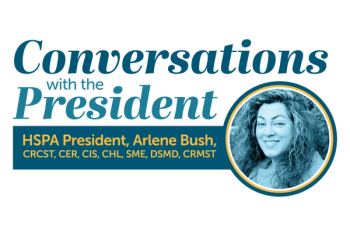
As Arlene Bush, CRCST, CER, CIS, CHL, SME, DSMD, CRMST, concludes her HSPA presidency, she reflects on advocacy, certification efforts, and collaboration, emphasizing mentorship and continued progress in sterile processing ahead of the 2026 conference in Baltimore.


At AORN 2026, Colleen Becker, PhD, MSN, RN, CCRN-K, highlights how nursing education must evolve with technology, generational learning styles, and workforce shortages to better prepare nurses for modern health care challenges.
At AORN 2026 in New Orleans, a colorectal SSI bundle shows how standardized intraoperative nursing practices, interdisciplinary collaboration, and data tracking can reduce infections and improve surgical outcomes.
At AORN26 in New Orleans, a poster highlights surgical smoke risks, urging nationwide evacuation policies to protect health care workers and patients and strengthen nurse-led advocacy for safer operating rooms.
At AORN 2026, experts highlight gaps in endoscope reprocessing, stressing pre-cleaning, visual inspection, and borescope use to improve patient safety and strengthen perioperative and sterile processing collaboration.
At AORN 2026, experts highlight how dedicated perioperative infection preventionists reduce surgical site infections, improve staff engagement, and drive ROI through standardized practices, real-time education, and data-driven strategies.
AORN26 highlights a colorectal SSI prevention bundle using evidence-based isolation techniques, interdisciplinary collaboration, and audit tracking to improve compliance and reduce infection risk in perioperative practice.
AORN26 highlights a multidisciplinary, culture-driven approach that reduced colon surgical site infections by over 27%, demonstrating how standardized bundles, collaboration, and perioperative alignment can significantly improve patient outcomes.
AORN26 highlights how using the teach-back method during PACU discharge education improved patient understanding and reduced surgical site infections, demonstrating the critical role of communication in infection prevention beyond the OR.
At AORN 2026, Erica Smith, DrPH, MBA, shares a practical framework for turning infection prevention guidelines into flexible, sustainable policies that help perioperative teams improve compliance without overwhelming staff or overcomplicating protocols.
AORN26 highlights how collaboration between the operating room and sterile processing department (SPD) reduced instrument contamination, minimized case delays, and improved patient safety, reinforcing the critical role of SPD partnerships in perioperative infection prevention.
AORN26 highlights a hands-on Scrub Bootcamp program that improves perioperative nurse readiness, confidence, and procedural skills, offering a scalable model to strengthen operating room training and patient safety.

The COVID-19 pandemic has accelerated a shift away from droplet-based precautions toward a “through the air” framework that recognizes aerosol transmission across a continuum of particle sizes. As measles, SARS-CoV-2, and influenza circulate simultaneously, this article explains why ventilation, respirators, and higher air change rates must become core infection prevention strategies in health care facilities.

Cloud fax, combined with AI and NLP, is helping health systems transform unstructured documents into FHIR-ready data. Experts say modernized fax workflows can support interoperability, reduce data silos, and help rural and under-resourced providers participate in digital health initiatives.
Fragmented systems make coordinated care difficult for people with intellectual and developmental disabilities. A new interoperability model using the eLTSS standard connects healthcare providers and community organizations to share person-centered service plans and improve outcomes for vulnerable populations.

When operating room delays and tray errors threatened efficiency, leaders at New York Presbyterian built a collaborative bridge with central sterile processing. Through shared metrics, workflow exchanges, and improved communication, first-case-on-time starts climbed from the 50 to nearly 90%.

The Association of periOperative Registered Nurses (AORN) Global Surgical Conference & Expo 2026 is coming up soon. It will be held in New Orleans, Louisiana, from April 11 to 14. To give a taste of what will be available, Infection Control Today® is publishing the as-yet unposted interviews from 2025. This interview is on a poster titled “Advocacy Reduces Infection Related to Anastomotic Leaks and Incidental Lacerations.”

At IDWeek, Mohammad Enayet Hossain, PhD, from ICDDR,B, shared a breakthrough: a portable point-of-care test that works in half an hour and has strong accuracy against RT-PCR. A huge step forward for outbreak readiness.
When a nationwide blood-culture bottle shortage squeezed hospitals, a Stanford-led team turned to machine learning by building and openly sharing tools that predict which patients are most likely to have bacteremia and when a culture can be safely deferred. The simplest version works as a quick bedside score, no new software required.